Money, Blocked: The Tarot Cards That Expose What's Keeping You Broke (And How to Break Free)
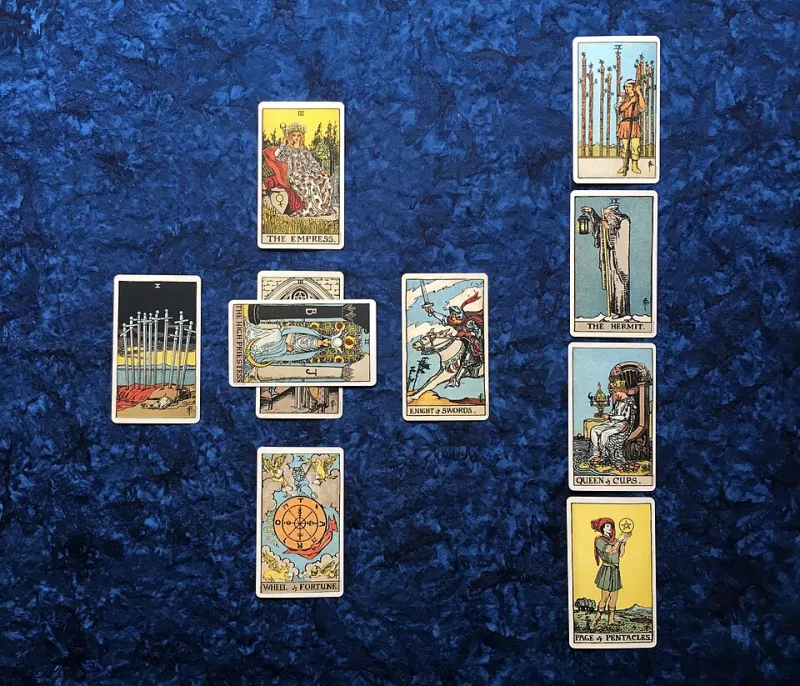
Photo: Nosferattus, CC0, via Wikimedia Commons
Most people treat tarot like a crystal ball—you ask a question, flip a card, and wait for the universe to hand you an answer. But the real magic of tarot, especially when it comes to money, isn't prediction. It's reflection. The cards act like a mirror, showing you the subconscious patterns, fears, and beliefs that are quietly running the show in your financial life.
And sometimes? That mirror is brutally honest.
If you've been doing everything "right"—budgeting, side hustling, investing—and abundance still feels frustratingly out of reach, there's a good chance a psychological block is working against you below the surface. Here at Fortune3 Cart, we've seen these seven tarot cards show up again and again when clients are wrestling with money issues. Let's break them down—and more importantly, let's break through them.
1. The Five of Pentacles: The Poverty Mindset Card
What it traditionally means: Two figures trudging through snow, left out in the cold while warmth and light glow through a stained-glass window nearby. This card speaks to hardship, lack, and the feeling of being on the outside looking in.
What it means for your finances: The Five of Pentacles often surfaces when someone has internalized scarcity as an identity. You might be in a genuinely tight financial spot—or you might be living as though you are even when you're not. The block here is a deep-seated belief that abundance is for other people. You see the window, but you don't believe you're allowed inside.
Your unblocking exercise: Write down three financial beliefs you inherited from your family growing up. Things like "money doesn't grow on trees" or "rich people are greedy." For each one, write a counter-statement that feels even slightly more true: "Money flows to people who create value" or "I am allowed to build wealth." You're not lying to yourself—you're widening the aperture of what you believe is possible.
2. The Devil: The Debt and Dependency Card
What it traditionally means: Two figures chained to a throne occupied by a demonic figure—yet the chains are loose enough to remove if they chose to. The card represents bondage, addiction, and the illusions that keep us trapped.
What it means for your finances: When the Devil shows up in a money reading, it often points to a toxic financial relationship—with debt, with a specific person, with a shopping habit, or with a job that pays well but slowly drains your soul. The uncomfortable truth this card delivers is that some part of you is choosing the chains. Maybe the debt feels familiar. Maybe the golden handcuffs feel safer than the uncertainty of walking away.
Your unblocking exercise: List one financial situation in your life that you know isn't serving you but haven't changed. Then ask yourself honestly: what would I lose if I fixed this? Sometimes we hold onto financial dysfunction because it provides something—an excuse, a sense of identity, a way to avoid a harder decision. Naming the payoff is the first step to releasing it.
3. The Four of Cups: The Missed Opportunity Card
What it traditionally means: A figure sits beneath a tree, arms crossed, staring at three cups on the ground while a fourth cup is offered by a mysterious hand from a cloud. The figure doesn't even notice.
What it means for your finances: This card shows up when someone is so focused on what they don't have that they're completely blind to the opportunities already in front of them. Disillusionment, boredom, or emotional withdrawal from financial reality are common culprits. You might be waiting for the "perfect" opportunity—the right market conditions, the right job listing, the right moment—while real chances pass by unnoticed.
Your unblocking exercise: Spend 10 minutes brainstorming income opportunities you've dismissed or ignored in the last six months. A freelance inquiry you didn't follow up on. A skill someone offered to pay you for. A side project you talked yourself out of. Pick one and take a single small action toward it this week.
4. The Seven of Swords: The Self-Sabotage Card
What it traditionally means: A figure sneaks away carrying five swords while leaving two behind—getting away with something, but not quite. This card speaks to deception, shortcuts, and strategies that ultimately undermine the self.
What it means for your finances: The Seven of Swords is the card of financial self-sabotage. It appears when someone unconsciously undermines their own success—blowing a savings account right before reaching a goal, picking fights with a boss right before a promotion, or quietly resenting the success of others in ways that block their own. Often, this card points to a fear of success rather than a fear of failure.
Your unblocking exercise: Think about a time you were close to a financial breakthrough and it fell apart. Be honest with yourself about what role you played. Journaling on this—without judgment—can surface patterns that are invisible in the moment but obvious in hindsight.
5. The High Priestess: The Intuition-Ignored Card
What it traditionally means: A serene, knowing figure seated between two pillars represents inner wisdom, mystery, and the knowledge that lives beneath the surface.
What it means for your finances: When the High Priestess appears in a money reading, it's often a signal that you already know what you need to do—you're just not listening. Maybe you've been ignoring your gut about a business partner. Maybe you sense a financial decision is wrong but you're rationalizing it anyway. The block here is a disconnection from your own financial instincts.
Your unblocking exercise: Before your next significant money decision, sit quietly for five minutes and ask yourself: "What do I already know about this that I haven't admitted yet?" Write whatever comes up without editing it. Your intuition is often the most accurate financial advisor you have—and it's free.
6. The Ten of Wands: The Burnout and Overload Card
What it traditionally means: A figure struggles under the weight of ten heavy wands, barely able to see where they're going. The card represents burden, overcommitment, and the exhaustion of carrying too much.
What it means for your finances: This card frequently surfaces for people who are working incredibly hard but still not getting ahead. The block isn't effort—it's strategy. You may be taking on every hustle available without pausing to assess whether any of it is actually moving you toward your goals. Overworking can be its own form of avoidance, keeping you too busy to confront deeper financial decisions.
Your unblocking exercise: Write down every income stream, financial obligation, and money-related task currently on your plate. Circle the ones that genuinely move you toward your goals. Put a line through the ones that are just... weight. What can you delegate, automate, or release?
7. The Moon: The Fear and Illusion Card
What it traditionally means: A moonlit scene with two towers, a wolf, a dog, and a crayfish emerging from water—all pointing to the murky, uncertain territory between the conscious and unconscious mind. The Moon represents fear, illusion, and things that aren't quite what they seem.
What it means for your finances: The Moon in a money spread often signals that anxiety and worst-case-scenario thinking are distorting your financial reality. You might be avoiding looking at your bank account because the truth feels too scary. Or you might be making decisions based on fear of a financial catastrophe that isn't actually coming. The block is the fog itself—and the only way through it is to turn on the lights.
Your unblocking exercise: Do a "financial reality check." Write down your three biggest financial fears, then research the actual likelihood of each one. More often than not, the fear is far larger than the reality. Replacing vague dread with specific numbers—even uncomfortable ones—gives you something concrete to work with instead of a monster in the dark.
The Bigger Reading
Tarot doesn't tell you what to do with your money. What it does—brilliantly—is show you what you're doing with your money on a subconscious level. These seven cards aren't curses or verdicts; they're invitations to look more honestly at the stories you've been telling yourself about wealth, worthiness, and what you deserve.
The next time one of these cards lands face-up in your spread, don't groan. Lean in. Your fortune is waiting on the other side of whatever that card is reflecting back at you.