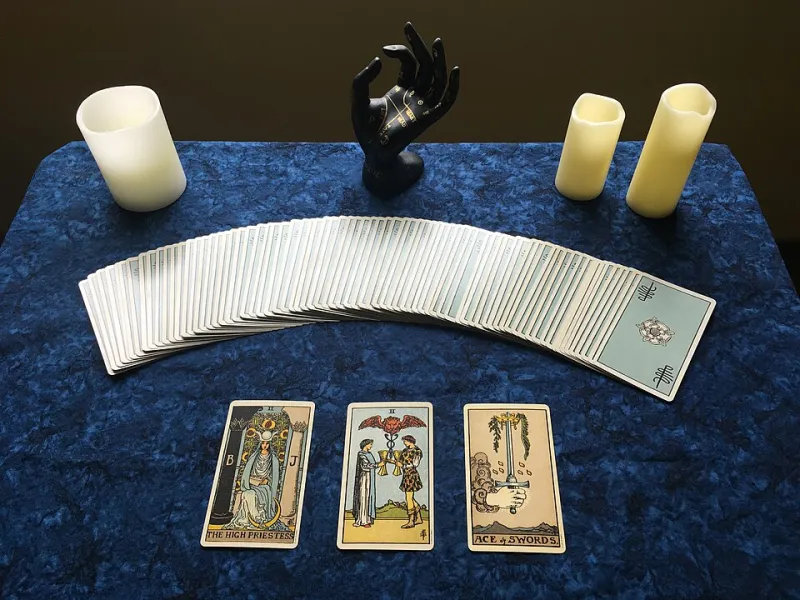
The Group Chat Is the Spread: Reading Your Relatives Like Cards This Holiday Season

Photo: USBGroup4, CC BY-SA 3.0, via Wikimedia Commons
Your family group chat does not care that you have a tarot deck. It still pings at 7:43 a.m. with a question about sweet potatoes and a passive-aggressive link to a recipe nobody asked for. But here is the thing: that chat is already a spread. Every message is a card. Every silence is a card. Every 'lol' is a card you can read if you stop pretending it is just logistics.
The Group Chat Is a Spread, Not a Group Project
Most people try to survive the holiday family chat by treating it like a group project with bad project management. Wrong frame. A group chat is a living three-card draw that keeps reshuffling. Someone plays the Emperor. Someone plays the Page of Swords. Someone plays the Five of Cups in the form of a thumbs-up. You are not there to fix the spread. You are there to read it.
Cast the Roles Without Casting Stones
The Emperor is the relative who needs a plan, a headcount, and a designated time for pie. They are not evil. They are scared of chaos. The Page of Swords is the one firing questions, screenshots, and 'just checking' texts at 11 p.m. They are curious, restless, and sometimes messy. The Queen of Cups is doing emotional labor in the background, remembering who is vegetarian and who is not speaking to whom. The silent relative is not blank. Silence in tarot is rarely empty. It is often a reversed card: something held back, something protected, something waiting for a safer room.
Then there are the loaded silences. A message that says 'Fine.' A question that gets answered three hours later. A cousin who likes every text except the one about bringing a plus-one. In a spread, those are not mistakes. They are information. Read the pause, not just the post.
The Three-Message Reading Method
Pick the last three messages in the chat that made your stomach tighten. Do not scroll for more evidence. Three is enough. Lay them out in your mind like a spread.
Message one: what is being asked? This is the surface request. 'Can you bring dessert?' 'Are you coming Friday or Saturday?' 'Did you see the group gift email?' Name it plainly.
Message two: what is being avoided? This is the card underneath. The dessert question might really be about control. The arrival time might really be about who gets the good guest room. The group gift email might really be about money nobody wants to discuss. You do not have to say this out loud. You just need to know what you are actually responding to.
Message three: what is being performed? This is the tone. The emoji. The extra exclamation points. The 'no worries at all!!' that has three too many exclamation points. Performance is not always fake. It is armor. Read it with compassion, then decide if you want to match it.
Example: Aunt Linda asks who is bringing the green bean casserole. Your cousin replies 'I thought you were.' Aunt Linda sends a single smiling emoji. That is not a casserole conversation. That is the Emperor meeting a reversed Page of Swords. The ask is food. The avoidance is responsibility. The performance is pleasantness. You can bring the casserole or not. You cannot unsee the spread.
A Boundary Ritual for Thanksgiving and December Gatherings
Before you reply to the next charged message, do a small ritual. It does not need candles, though candles are nice. It needs a pause.
First, mute the chat for sixty seconds. Consider it a shuffle. Second, name the card you are looking at: 'This is the Emperor asking for control,' or 'This is the Page of Swords spiraling.' Naming it gives you a little distance. Third, send one sentence that is true and boring. Boring boundaries travel well.
Try: 'I can bring rolls, but I am not coordinating the whole menu.' 'I am available until eight, then I am off my phone.' 'I am not discussing that at dinner, but I am happy to see you.' You are not trying to win the spread. You are trying to stay in your own card.
If the chat goes full Tower, stop reading. A Tower moment is not a summons. You are allowed to close the app, put the phone face down, and let the group chat have its own character arc. The Hermit is also a valid holiday archetype. So is Do Not Disturb.
The Point Is Not to Diagnose Your Family
Tarot is a mirror with a sense of humor. Reading your family chat as a spread will not turn your relatives into archetypes who finally admit they are wrong. It will help you stop reacting to every ping like it is a verdict. The Emperor can keep his headcount. The Page of Swords can keep their links. You can keep your peace, your receipts, and your right to leave the group chat on read.
After all, the cards are not here to make your family behave. They are here to help you notice what role you keep volunteering for. This holiday season, maybe you do not need to be the fixer, the peacekeeper, or the designated emotional caterer. Maybe you just need to draw one clear card and play it.