Pick Your Poison: Oracle Cards, Tarot, or Pendulum — Which Divination Tool Was Made for Your Soul?
Photo: Atell Rohlandt, CC BY-SA 4.0, via Wikimedia Commons
So you've decided you want guidance from beyond the everyday. Maybe you're navigating a big life decision, trying to understand a complicated relationship, or just feeling like the usual advice columns aren't cutting it anymore. Welcome to the club — millions of Americans are turning to divination tools right now, and the options can feel overwhelming.
Tarot. Oracle cards. Pendulums. They're all over TikTok, Etsy, and your most spiritually curious friend's bookshelf. But here's what most beginner guides skip over: these tools are not interchangeable. Each one operates on a different frequency, answers different kinds of questions, and vibes with different types of seekers.
This is your no-fluff breakdown. We're going deep on all three so you can stop second-guessing your spiritual toolkit and start actually using it.
First, Let's Talk About What Divination Actually Does
Before we compare tools, let's get one thing straight: divination isn't about predicting a fixed future. Think of it more like a conversation with your higher self, the universe, or whatever framework resonates with you. These tools create a structured way to access intuition, surface unconscious thoughts, and invite reflection that ordinary thinking tends to skip.
They work best when you bring a genuine question and an open mind. They work worst when you're looking for someone — or something — to just tell you what to do.
Okay. Now let's get into it.
Tarot: The Deep-Diver's Tool
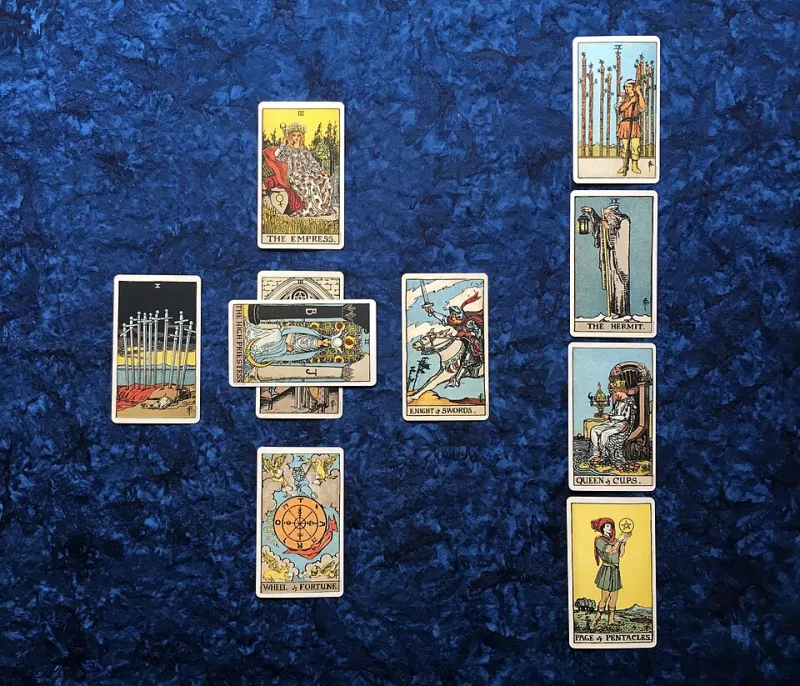
What it is: A 78-card deck split into the Major Arcana (22 cards representing big life themes and archetypes) and the Minor Arcana (56 cards covering everyday situations across four suits). Each card carries layered symbolism rooted in centuries of esoteric tradition.
What it's best for: Complex, nuanced questions. Tarot shines when you need to understand why something is happening, not just what to do about it. It's particularly powerful for exploring relationships, personal growth, career crossroads, and recurring patterns in your life.
The learning curve: Real talk — tarot takes time. With 78 cards, each carrying multiple meanings depending on position and context, it's a commitment. Most serious readers spend months (sometimes years) developing fluency. That said, you don't need to memorize everything to start. Many readers work intuitively alongside a guidebook.
Who it's for: Analytical thinkers who love symbolism, people who journal or self-reflect regularly, anyone who wants a system with depth and structure. If you've ever gone down a Wikipedia rabbit hole at midnight because you couldn't stop learning, tarot is probably your tool.
The Fortune3 Cart take: Tarot is like a therapy session with the universe. It doesn't give you easy answers — it gives you better questions.
Oracle Cards: The Flexible, Feel-Good Option
What it is: Unlike tarot, oracle decks have no fixed structure. A deck can have any number of cards, any theme (celestial bodies, spirit animals, affirmations, goddesses — you name it), and any kind of message system the creator designed. The variety is genuinely staggering.
What it's best for: Daily check-ins, emotional support, and open-ended reflection. Oracle cards are fantastic when you need a nudge, a reminder, or a dose of encouragement rather than a deep psychological excavation. They're also great as a complement to tarot — many readers pull an oracle card alongside a tarot spread for added clarity or a "big picture" message.
The learning curve: Minimal. Most oracle decks come with a guidebook that explains each card clearly, and the messages are usually more direct than tarot's layered symbolism. You can pick up an oracle deck today and do a meaningful reading tonight.
Who it's for: Beginners, creatives, people who find tarot intimidating, anyone who wants a gentle daily spiritual practice. Also ideal for those who are drawn to a specific theme — there's an oracle deck for literally every aesthetic and spiritual tradition you can think of.
The Fortune3 Cart take: Oracle cards are the universe's way of texting you a pep talk. Sometimes that's exactly what you need.
Pendulum: The Yes/No Oracle
What it is: A weighted object — usually a crystal, metal bob, or even a simple ring — suspended on a chain or cord. The pendulum responds to questions through directional movement: typically swinging forward/backward for yes, side-to-side for no, and circular for uncertain or "ask differently."
What it's best for: Specific, binary questions where you need a clear directional answer. "Should I take this job offer?" "Is this person trustworthy?" "Am I on the right path with this decision?" The pendulum doesn't do nuance — but for yes/no clarity, it's remarkably effective for many practitioners.
The learning curve: Low entry, but requires calibration. Before using a pendulum, you need to establish your personal yes/no signals (they can vary by person and even by pendulum). Ideally, practice with questions you already know the answers to. The bigger challenge is learning to quiet your own desires enough to receive a clear signal — the pendulum picks up on your energy, including wishful thinking.
Who it's for: Decisive types who hate ambiguity, people who already trust their gut and want confirmation, practitioners who want a fast, portable tool. Also great for those who are drawn to energy work or dowsing traditions.
The Fortune3 Cart take: The pendulum is the universe's lie detector — but only if you're honest with yourself about what you're really asking.
Quick Quiz: Which Tool Is Calling Your Name?
Answer these honestly and tally your letters:
1. When you need guidance, you want:
- A) A full picture with context and layers — (T)
- B) A gentle message or affirmation to reflect on — (O)
- C) A straight answer, fast — (P)
2. Your relationship with symbolism is:
- A) I love it — the more layers, the better — (T)
- B) I like it when it's clear and approachable — (O)
- C) I prefer direct communication over metaphor — (P)
3. How much time do you want to invest in learning your tool?
- A) I'm in it for the long haul — (T)
- B) I want something I can use right away — (O)
- C) I want to learn the basics and go — (P)
4. The questions you bring to divination are usually:
- A) Big, complex, "why is this happening" type stuff — (T)
- B) Emotional check-ins and daily guidance — (O)
- C) Specific decisions I'm trying to make — (P)
Mostly T: Tarot is your match. Lean into the depth. Mostly O: Oracle cards are your people. Start building your deck collection. Mostly P: Grab a pendulum and start calibrating. You're a natural. A mix: Consider starting with oracle cards as your foundation and adding tarot or a pendulum as your practice grows.
So... Which One Actually Works?
Here's the honest answer: all of them work — for the right person, asking the right questions, in the right headspace. The "best" divination tool is the one you'll actually use, the one that feels natural in your hands, and the one that consistently opens something up in your thinking.
Divination isn't magic in the Hollywood sense. It's a mirror. The tool just determines the shape of the reflection.
Start with one. Get comfortable. Then, if you're curious, explore the others. Most dedicated practitioners end up with all three in their spiritual toolkit — each one pulling its weight in different seasons of life.
Ready to go further? Browse Fortune3 Cart's tarot reading guides and start pulling cards today. The universe has been waiting to talk.